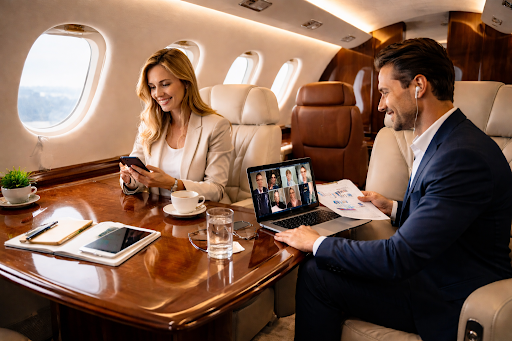
For today’s executives, time is the most valuable asset—and increasingly, private jets are no longer downtime. With the rise of high-speed satellite internet and improved onboard technology, private aviation has evolved into a fully functional mobile office, allowing leaders to stay connected, productive, and responsive while in the air.
This shift is redefining how private flyer’s view flight time and how they plan their travel.
Productivity Without Compromise
Private aviation has always offered control over schedules and destinations. Now, reliable high-speed connectivity adds a new dimension: the ability to work seamlessly from takeoff to landing.
Executives can:
Join live video calls
Review and edit documents in real time
Communicate with teams and clients
Access cloud-based platforms without interruption
What was once travel time is now usable, uninterrupted work time—often more focused than on the ground.
Why Connectivity Matters More Than Ever
Remote and hybrid work environments have changed expectations. Decision-makers are no longer willing to disconnect for hours simply because they are in transit. For many, connectivity is not a luxury feature—it’s a requirement.
Private jets equipped with advanced satellite internet allow executives to:
Maintain momentum during busy travel schedules
Respond quickly to time-sensitive matters
Reduce the need to rearrange meetings around flights
This capability is especially valuable during multi-city travel, global events, and compressed schedules.
A Better Environment for Focus
Beyond internet speed, the private jet cabin itself supports productivity in ways commercial travel cannot. Quiet cabins, customized layouts, and privacy create an environment conducive to focused work.
Without terminal congestion, gate delays, or shared cabin distractions, executives often find they can accomplish more in-flight than during a typical office hour on the ground.
The result is not just connectivity, but quality productivity.
Technology as a Competitive Advantage
Operators and platforms are increasingly prioritizing aircraft with modern connectivity systems because they influence booking decisions. Aircraft that support reliable, high-speed internet are more attractive to business travelers who view connectivity as essential.
As a result:
Connectivity has become a differentiator between aircraft
Flyers are more selective about onboard technology
Flight planning increasingly includes connectivity requirements
Private aviation is aligning with how modern businesses operate—not around fixed offices, but around mobility.
The Impact on Travel Decisions
As private jets become more capable mobile workspaces, executives are adjusting how they travel. Shorter trips become more feasible, same-day returns more common, and multi-leg itineraries less disruptive.
Flying private is no longer just about arriving refreshed—it’s about staying fully engaged throughout the journey.
Looking Ahead
The concept of the private jet as a mobile office will continue to expand as connectivity improves and onboard systems become more integrated. The line between office and aircraft is fading, replaced by a model where work travels with the executive.
For private flyers, this evolution reinforces a simple idea: the value of private aviation isn’t just where it takes you—it’s what you can accomplish along the way.
About the Author
Keira Svensen is the Content & Editorial Director of Virtual Hangar Media, where she leads editorial strategy and storytelling across private aviation, aircraft markets, and emerging flight technologies. With a focus on data-driven reporting and modern aviation trends, Keira helps shape how owners, operators, and travelers understand the evolving private aviation landscape.