
Citation CJ1
Light Jet by Cessna


General Specifications
Light Jet
Jet Size Category
7
Passengers
10600 lbs
Max Payload
1336 mi
Range
377 mph
Max Speed
327 mph
Cruising Speed
3280 ft
Takeoff Distance
2488 ft
Landing Distance
Cabin Dimensions: 244 ft³
Cabin Length

11.0 ft
Cabin Width

4.75 ft
Cabin Height

4.67 ft
Cargo Capacity: 59 ft³
Personal Items
Carry Ons
Checked Bags
More About Citation CJ1
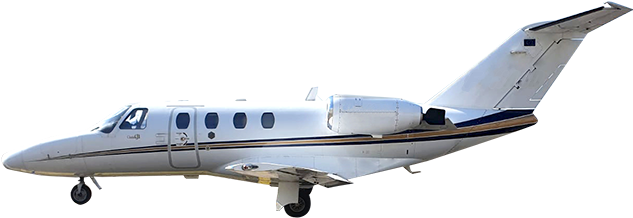
The Citation CJ1 stands proudly as the second generation of the highly acclaimed Citation Jet series. Building upon the successes of its predecessor, the Citation Jet, the CJ1 incorporates numerous enhancements in economy and performance, cementing its status as a refined and reliable private jet.
At the core of the Citation Jet’s design philosophy are three key elements: simplicity, economy, and performance. Striking the right balance proved challenging, particularly in crafting an aerodynamically efficient structure that remains cost-effective and responsive. Departing from earlier Citations with straight wings, the Citation Jet embraced a natural laminar flow wing, a joint achievement by Cessna and NASA after four years of dedicated work. This innovative wing design prolongs the onset of airflow separation, leading to a remarkable ten to fifteen percent improvement in lift-to-drag characteristics when compared to previous straight-wing configurations.
One of the CJ1’s standout features is its exceptional fuel efficiency, with an average consumption of 134 gallons per hour. This economy is largely attributed to Cessna’s choice of engines – the two Williams/Rolls-Royce FJ44-1A turbofans, each capable of delivering 1,900 pounds of thrust during takeoff.
Furthermore, the CJ1’s cost-effectiveness extends to its flight systems, known for their reliability and simplicity. Equipped with the Pro Line 21 avionics package, complete with Primary Flight Display (PFD) and Multi-Function Display (MFD) flat-panel screens, the CJ1 was the first business jet to incorporate this technology, barring the massive Boeing Business Jet.
Operating the CJ1 is a breeze, thanks to numerous automated systems designed to cater to forward-thinking business professionals who may opt to fly their private jets. These systems streamline operations and simplify avionics, reducing direct operating costs. Moreover, the CJ1’s single-pilot operability enhances flexibility in flight operations.
Despite its economical flight characteristics, the CJ1 offers an impressive payload capacity. Its three generous baggage compartments can accommodate up to 832 pounds of luggage, ensuring travelers’ needs are met. The CJ1’s design prioritizes versatility, enabling it to operate effectively from short runways. It boasts a takeoff distance of 3,280 feet at sea level, with a slight increase to 5,870 feet on runways at an altitude of 5,000 feet.
Comparing the CJ1 to its predecessor, the Citation Jet, reveals noteworthy improvements. With a 300-pound increase in maximum takeoff weight and a corresponding boost in maximum fuel weight by 300 pounds, the CJ1 provides better range/payload flexibility, granting owners more diverse flight planning options. Surprisingly, despite its increased weight, the CJ1 outpaces the Citation Jet in speed, notably in its climb rate. The CJ1 reaches 41,000 feet in a mere 32 minutes, significantly quicker than the Citation Jet’s 59-minute ascent to the same altitude.
The cabin layout closely resembles that of the CJ1’s predecessor, with seating for five passengers in a club arrangement complemented by a side-facing seat. The full-length dropped aisle enhances the cabin’s sense of space. Additionally, a double-sealed door mechanism akin to that of a vault contributes to reduced cabin noise, ensuring a comfortable and peaceful journey.
In conclusion, the Citation CJ1 emerges as an ideal choice for small businesses and individuals seeking an economical private jet for short-range missions, typically spanning slightly over an hour. It unlocks nonstop travel possibilities, such as routes from Los Angeles to Aspen and Washington, D.C. to Miami.
Similar Aircraft













.png)
