
Citation Encore
Light Jet by Cessna


General Specifications
Light Jet
Jet Size Category
7
Passengers
16630 lbs
Max Payload
1918 mi
Range
430 mph
Max Speed
372 mph
Cruising Speed
3490 ft
Takeoff Distance
2770 ft
Landing Distance
Cabin Dimensions: 368 ft³
Cabin Length

17.25 ft
Cabin Width

4.67 ft
Cabin Height

4.58 ft
Cargo Capacity: 69 ft³
Personal Items
Carry Ons
Checked Bags
More About Citation Encore
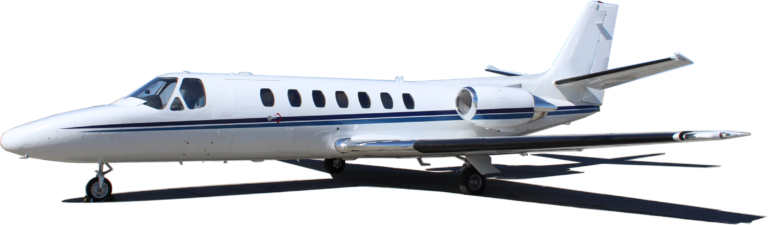
Within Cessna’s impressive lineup of private jets, the Citation Encore stands as the “Encore” to the successful Citation Ultra, offering an exceptional blend of versatility, long-haul capabilities, short-field performance, and a remarkable cargo capacity. Renowned for its cabin comfort, smooth in-flight performance, and cost-effective operations, it remains a favorite among passengers and pilots alike.
The cabin, accommodating up to eight passengers in fully reclinable seats, stretches an impressive seventeen feet and five inches, making it the longest cabin among light private jets. Ingenious design choices, such as seamless wall panels, indirect lighting, and strategically placed mirrors, create an illusion of even more space within its 307 cubic feet volume. Passengers are treated to an array of amenities, including individual flat-panel entertainment systems with audio jacks, power outlets, and the MagnaStar 200 radio phone. Boarding has also been simplified with a newly-designed airstair entryway, offering particular convenience, especially for passengers in high heels. The Encore doesn’t skimp on storage either, providing 43 cubic feet of external baggage space along with an additional 28 cubic feet in the interior, totaling over 1,400 pounds of capacity.
Taking to the skies, the Citation Encore can confidently depart from a sea-level runway in just 3,490 feet. Even at an altitude of 5,000 feet and a temperature of 77°F, it requires a mere 5,750 feet for takeoff. But this jet isn’t just quick off the ground; it also boasts impressive high-altitude performance. Within a mere thirteen minutes, it ascends to 37,000 feet, where it reaches its maximum cruise speed of 0.74 Mach. For long-range cruises, it maintains a speed of 376 knots at its maximum certified flight level of 45,000 feet.
The Encore’s exceptional speed can be largely attributed to its wing design, a nod to Cessna’s tradition of simplicity and efficiency. Collaborative efforts between a Cessna aerodynamicist and a NASA expert resulted in a redesigned straight wing for the Citation line. This innovative design features a spacious leading-edge radius and a level upper surface, optimizing airflow distribution, minimizing drag, and ultimately increasing the Encore’s cruise speed. These wings enable the Encore to operate on runways as short as 2,439 feet for landing and 3,490 feet for takeoff, even when loaded to its maximum takeoff weight of 16,630 pounds.
However, the Encore’s speed isn’t solely thanks to its wings; credit also goes to the Pratt & Whitney Canada PW535A turbofan engines. Each engine delivers a substantial 3,400 pounds of thrust, nearly 400 pounds more than the Ultra, all while achieving a 16% more efficient specific fuel consumption compared to the P&W JT15D-5D engines utilized on the Ultra.
In the realm of avionics, the Honeywell Primus 1000 suite demonstrates the power of simplicity. Engineers have thoughtfully consolidated multiple displays into four sleek screens, eliminating confusion and improving pilot hand-eye coordination. These screens position the relevant controls directly on their faceplates, further enhancing flight performance. The Encore’s engines generate sufficient bleed air to support its various systems, including anti-icing, cabin pressurization, and air conditioning. Notably, the temperature control system has been updated to utilize both bleed air and an electrical vapor-cycle machine. This innovative design not only serves as a backup air conditioning system on sweltering days but can also be activated on the runway to cool the cabin before engine startup. The system conveniently allows separate temperature settings for the cabin and cockpit.
Attention to detail, a hallmark of Cessna’s private jets, extends to the Encore’s various features. It incorporates a trailing link landing gear, ensuring smooth taxiing and gentle landings. Additionally, it can be single-pilot operated, offering flexibility to its users. To reduce engine noise, a new forced mixer nozzle has been added, further enhancing the in-flight experience. Furthermore, the Encore’s new fuel heaters eliminate the need for fuel additives, contributing to its overall efficiency. Several minor updates collectively allow the Encore to carry 344 pounds less fuel than the Ultra while still achieving a longer range.
In summary, the Cessna Citation Encore fulfills the dreams of those seeking a private jet that can handle substantial loads over extended distances while ensuring passenger comfort and pilot satisfaction. This aircraft epitomizes versatility, economy, luxury, and high-performance, making it a captivating sight both in the skies and on the runway.
Similar Aircraft













.png)
